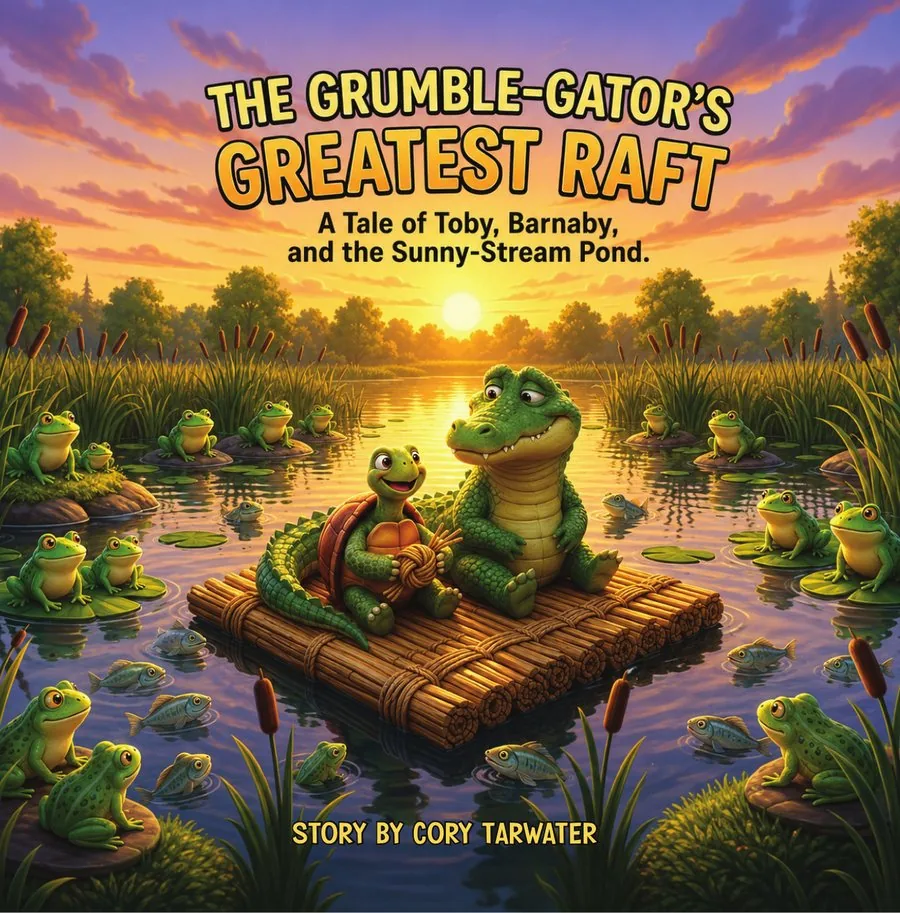
For parents, grandparents & caregivers
A Family Reading Guide
Story time is short. The talk after it can last a lifetime. This free guide helps you turn The Grumble-Gator’s Greatest Raft into a real conversation about kindness, feelings, and what to do when someone is unkind. Made for kids ages 3–8. No sign-up. Just read, pause, and talk.
Before you start
Four little read-aloud tricks
Start with the cover
Before page one, look together. “Who do you think the Grumble-Gator is? How do you think he feels?” Guessing gets kids leaning in.
Give them voices
Go big and gruff for Barnaby. Soft and steady for Toby. Kids remember how a character sounds.
Make the THWACK loud
Slap your knee on the THWACK. Let your child do it too. Then read the quiet parts slow and quiet. The contrast does the teaching.
Pause. Then wait.
Ask a question and count to five in your head. Little ones need a moment. The best answers usually come after the silence.
While you read
Pause-and-talk moments
You don’t need all of these. Pick two or three. If your child wants to keep reading, keep reading — you can come back to them.
When Barnaby splashes Toby
“Out of my way, Tiny-Shell!”
How do you think Toby feels right now? Has anyone ever called you a name you didn’t like?
When the minnows say “Hit him back!”
“Use your hard shell to bop him on the nose!”
What do you think Toby should do? What might happen if he hits back?
Toby remembers his father’s words
“A fist can break a branch, but a kind word can plant a forest.”
What do you think that means? What’s a kind word that could “plant a forest”?
Barnaby sitting alone in the mud
“…sitting all alone in the mud, looking very grumpy.”
Why do you think Barnaby is alone? Do you think he’s happy being mean?
“I don’t know how to tie knots.”
“Nobody had ever asked him to build anything before.”
How do you think it felt for Barnaby to be asked to help? When do you feel good about yourself?
The sunset apology
“Being big just means you have more room for friends.”
Barnaby said sorry. Toby forgave him. Is saying sorry easy or hard? Why?
After the last page
Conversation starters
Great for the car, the bath, or bedtime — any quiet moment later in the day.
About Barnaby
- Why do you think Barnaby acted so grumpy at first?
- What changed him — was it the raft, or something else?
- Can someone who was unkind become a good friend?
About Toby
- Was Toby brave? What made him brave?
- Toby didn’t hit back. Does that mean he let Barnaby win?
- What else could Toby have done? (Tell a grown-up is a great answer!)
About you
- Is there a “Barnaby” at school or on the playground?
- Who might need someone to sit with them on the raft?
- What’s one kind thing you could do tomorrow?
Meet them where they are
Tips by age
Name the feeling
Keep it simple. Point at the pictures. “Toby looks sad. Barnaby looks mad.” Make the faces together in a mirror. Naming feelings is the whole lesson at this age.
Talk about choices
Ask “What else could he do?” a lot. Role-play it: you be Barnaby, they be Toby. Then switch. Kids this age learn by acting it out.
Dig into the why
Talk about why people bully. Barnaby thought being big meant being scary. Ask: “Why might a kid act tough when they feel small inside?”
“A fist can break a branch, but a kind word can plant a forest.”— Toby’s father, from The Grumble-Gator’s Greatest Raft
Keep the story going
Three things to try at home
Build a raft together
Craft sticks, twigs, or straws and some string or tape. Work on it as a team, like Toby and Barnaby. Then float it in the bath or the sink.
Plant a kindness forest
Every time someone in the family says or does something kind, cut out a paper tree and tape it to the fridge. Watch the forest grow all week.
Color & play
Free coloring pages, kindness BINGO, bookmarks and more. No email needed — just print and go.
A note for grown-ups
If the story hits close to home
Sometimes a book opens a door. Your child might say, “That happens to me.” Or even, “I do that sometimes.” Both are gifts. Stay calm. Listen first. Thank them for telling you.
Toby chose kindness — but kids should always know it’s okay, and smart, to tell a trusted grown-up when someone keeps being unkind. Being kind and asking for help go together.
More help: Talking to little kids about bullying · When your child comes home sad about a friend · Kindness, not hitting back
Teacher or librarian?
There’s a classroom version too
The free Educator Kit has a full discussion guide, SEL map, and the Kindness Raft activity.
Homeschooling? Try the free One-Week Kindness Unit: five short days of reading, writing, science and kindness.